Why a Clear Rule Needs a Clear Boundary
Clear rule boundaries help readers identify which instruction governs a decision, where to find the responsible authority and what to do when documents differ.

Which instruction governs this decision, and who can explain it? A clear rule boundary answers those questions before a member of the public, a casino operator or a public official has to guess. It also helps an institution explain how its rule relates to the documents used in day-to-day administration.
Compare the documents
A boundary problem can arise even when every document sounds clear on its own. A casino’s visitor notice may describe conduct inside the venue, while a public authority’s procedure governs how officials handle a licensing enquiry. The reader needs to know which document applies to the decision in front of them.
Start by identifying the decision, then compare the documents that address it. Look for the issuer, intended audience, subject and any stated relationship between them. A visitor notice does not automatically settle how a public body must handle a formal request, and an administrative procedure does not automatically govern conduct on the casino floor.
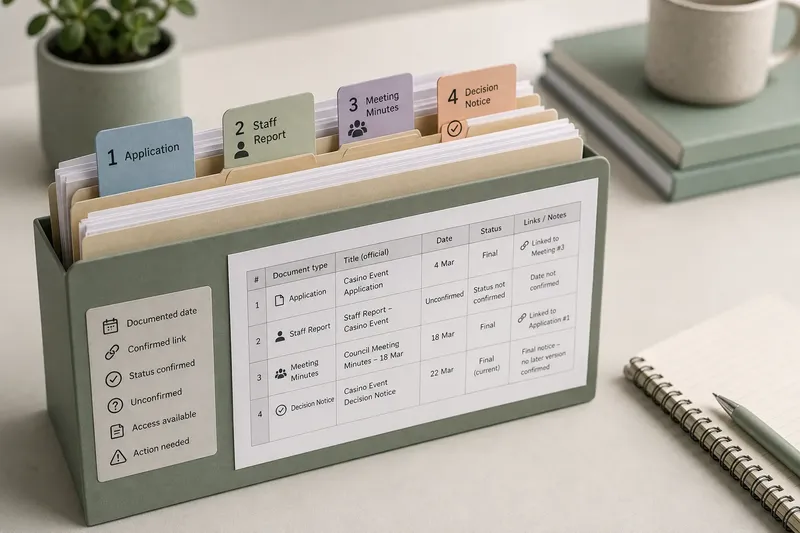
Think of the documents as separate folders in a filing cabinet: a label helps you find the relevant folder, but it does not make its contents interchangeable with another folder’s.
Trace the decision path
Follow the actual route a question takes: who receives it, what action follows, and which office makes the decision. Distinguish the person who explains a rule from the person authorised to apply or interpret it. If the text does not name that authority, the gap is worth raising with the institution that issued or administers the document.
Say a public authority has a visitor notice and a licensing procedure, and a reader asks whether a casino’s entry rule affects a licensing decision. The reader identifies the question as one about licensing, checks the procedure’s stated audience and subject, then asks the named licensing office how the entry notice relates to that process. The observable result is a routed question and a reply from the relevant office; if the procedure does not identify that office, the reader can ask the authority to identify who handles the interpretation.
Document the boundary
Use this checklist to make a boundary question answerable. For each item, record the observation and follow the corresponding decision; if the observation is missing or conflicting, use the alternative action rather than treating an assumption as settled.
- Issuer: Check the name of the organisation that published each document; if the issuer is clear, contact it about its own rule, but if it is missing, ask the organisation that supplied the document to confirm its source.
- Audience: Check whether the text names visitors, employees, contractors, an operator or public officials; if your role is included, read the instruction as potentially relevant, but if it is unclear, ask the issuer which roles it covers.
- Decision: Check whether the document concerns the decision you need addressed; if it does, use it to frame your question, but if it concerns a different decision, ask which document governs yours.
- Setting: Check whether the rule applies at the venue, within an organisation or during a named administrative process; if your situation matches, follow that stated context, but if it does not, ask whether another rule applies.
- Trigger: Check what event activates the instruction, such as receiving a formal request; if that event has occurred, follow the stated route, but if the trigger is absent or vague, ask the issuer when the rule takes effect.
- Cross-reference: Check every named policy or procedure; if the relationship is explained, consult the cited text, but if the link is bare or broken, ask the issuer what the reference adds.
- Decision-maker: Check which role or office handles interpretation or exceptions; if one is named, direct the question there, but if none is identified, ask the issuing institution to route it to the authorised decision-maker.
Keep the answer with the documents and the question that prompted it. If two official texts appear to conflict, record the relevant wording and ask the responsible institution to clarify which applies to the specific decision. Do not treat silence in one document as permission to disregard another.
Questions about boundaries?
What if two documents seem to conflict?
Identify the decision at issue and compare each document’s issuer, audience and subject. Ask the institution responsible for that decision to explain which text applies and how the documents relate.
Does a venue notice govern public officials?
Not necessarily: a venue notice and an authority’s procedure may address different audiences and decisions. Check each document’s stated scope, then ask the relevant institution if the relationship remains unclear.
Who can clarify an ambiguous rule?
Look for a named office or role authorised to administer or interpret the rule. If the document names none, contact its issuer and ask who can provide an authoritative explanation.
Must every exception appear in the rule?
No rule needs to catalogue every possible situation, but a material exception or decision-maker should be identifiable where it affects how the instruction applies. If a borderline case is not addressed, ask the responsible authority rather than inventing an exception.
Keep the answer traceable
For a clear rule boundary, preserve the exact document title, issuing organisation and the section that prompted the question. That record lets the next reader distinguish an official clarification from an informal explanation and return to the same wording.
When the answer changes how a process is handled, ask whether the clarification is recorded in an updated notice, procedure or written response. A traceable explanation helps staff, visitors and public bodies use the same boundary without pretending that separate rules have become one.