How Casino Regulation Became a Governance Question
Casino regulation becomes a governance question when public choices create duties for institutions. Learn how law, licensing and public accounts shape those duties.

When does casino regulation become a governance question? It happens when a public authority must do more than prohibit or permit gambling: it must explain how its decisions are made and account for the powers it exercises. Casino regulation, then, is also a question about public authority.
Choices create duties
A prohibition sets a boundary around what is forbidden and gives officials an enforcement task. Authorisation creates a different set of duties: public bodies may need to assess applications, set conditions and explain how those conditions will be administered.
These are possible policy arrangements, not a universal historical sequence. A jurisdiction may prohibit casino gambling, permit a limited form or establish licensing. Its laws and political choices determine which arrangement applies and what the public authority must explain.
To understand a particular change, compare the relevant legislation with policy papers and records that establish public bodies. Look for the powers those documents assign, such as issuing licences or reviewing an operator’s conduct. The useful question is not simply whether the law changed, but what new public decisions the change required.
Licensing and public trust
A licence is permission under defined rules, not an endorsement of every part of an operator’s business. Depending on local law, a licensing authority may assess an application, impose conditions, monitor compliance or respond to a breach.
Trust depends partly on whether the public can understand what the licence does and does not settle. An approval for gambling operations may not resolve a separate decision about the proposed site. Clear public notices should explain the scope of each decision, the reasons that can be considered and the process for raising concerns.
Imagine a fictional borough where a national regulator considers an operator’s licence while the borough council considers planning permission for a site. A resident reads the council’s planning notice and asks how the proposed building use will be assessed; separately, the resident asks the regulator how licence conditions are considered. The expected result is two explanations of distinct decisions, rather than an assumption that either authority has settled both.
A licence is like a key cut for one lock: it opens only the door its terms and governing rules allow. The comparison also points to a public duty: explain which door the permission opens, and which decisions remain separate.
Accounts and accountability
Casino-related public receipts, such as taxes or licence fees, raise a question of accounting: which public body records them, and where can the public see how they are reported? Receipts alone do not establish improper influence. They do make transparent accounting and scrutiny relevant.
Consult the applicable budget, public accounts and regulator’s published remit. Treat claims about funding public services as policy claims unless the relevant budget or accounts show how the money is handled. Keep the collection of revenue distinct from the decision to grant or oversee a licence; these functions may belong to different institutions.
Accountability also depends on how an authority explains its work. A clear report should identify the decision-maker, describe the power being used and show where the public can find the reasons or records. If those details are missing, ask the relevant finance or oversight office to identify the public reporting process.
Make public records useful
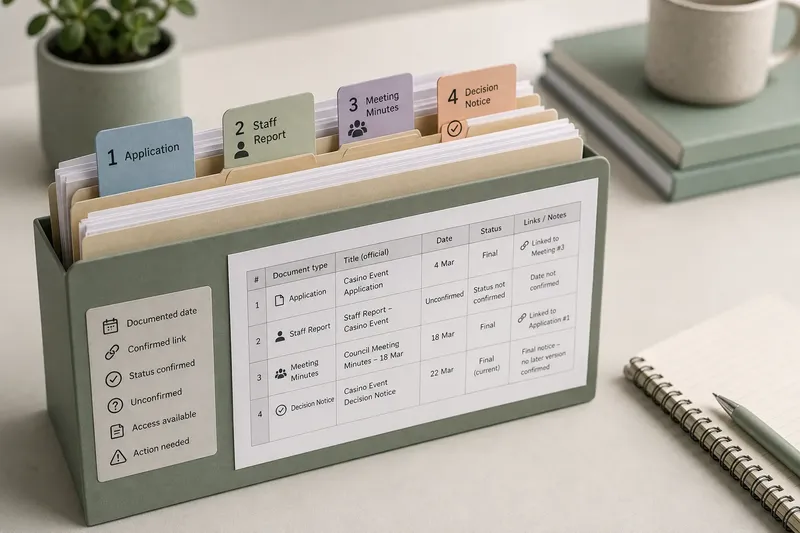
Readers can assess a proposal by tracing its public record, rather than treating casino regulation as a single decision. For each item below, check the document and follow the decision that its contents support:
- Check current law or official policy for authority to operate casinos. If it names a licensing body, use that name to find its application rules; if not, ask the government office responsible for gambling policy which law and body apply.
- Check the licence or application notice for the decision-maker and the reasons it may consider. If both are stated, use them to understand the scope of the decision; if either is missing, ask the issuing office to identify the authority or publish the relevant criteria.
- Check planning records for a separate land-use approval. If they identify a process, use it for questions about the site and building; if they do not, ask the local planning office how the proposal is handled.
- Check the rules for monitoring licence conditions. If they name a responsible office and process, use those details for a compliance concern; if they do not, ask the regulator to identify the monitoring arrangements.
- Check the published complaint procedure and the issues it covers. If it covers the concern, submit it through that channel; if it does not or is silent, ask the regulator which office reviews that type of complaint.
- Check public budgets or accounts for casino-related receipts and the office responsible for recording them. If the documents identify both, use them to follow the reporting trail; if either is absent, ask the relevant finance authority where the receipts are recorded.
This record trail can clarify how a decision was made without settling whether casino policy is desirable. That judgement involves weighing the reasons and assumptions offered in public against the legal powers the authorities are using.
Questions about casino governance?
What changes when casinos are authorised?
When a jurisdiction permits casino operations, public authorities may need rules for applications, conditions and oversight in place of, or alongside, a prohibition. The local legislation and official records show which duties were assigned.
Does a casino licence settle planning?
Not necessarily: licensing and planning may be separate decisions under different rules. Read the regulator’s documents and local planning records to see what each approval covers.
What makes a decision understandable?
A public explanation should name the authority, state the power it is using and describe the reasons relevant to its decision. It should also point readers to the public record and the procedure for submitting a concern.
Where are casino-related receipts reported?
Consult the applicable budget, public accounts or finance authority’s reports to see which body records relevant receipts. If the reporting route is unclear, ask the finance or public accounts office rather than inferring an allocation from a policy statement.
Read the local record
Casino regulation becomes a governance question when public choices assign institutions real administrative duties. Local laws and official records show what those duties are, how separate decisions relate and what the public can expect an authority to explain.
For anyone examining casino regulation, the most useful point is to distinguish permission from public agreement. A licence records a decision made under rules; transparent reasons and accessible accounts let people judge how that decision was reached.