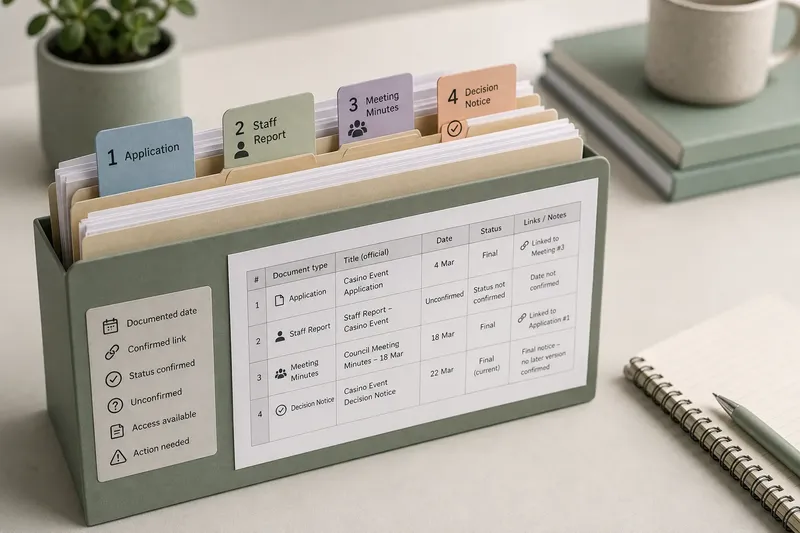
Casino Decision Notices and the Reasons Behind Them
Casino decision notices make a ruling easier to understand by showing its status, the record behind it and what readers can—and cannot—infer.

What did the casino regulator decide, and what record supports that answer? A casino decision notice should let readers identify the ruling and locate its documentary basis without confusing the public notice with the formal decision itself.
Separate notice from record
Treat the notice as a short public index to the decision, not as a second version of the decision document. Its distinctive job is to orient a reader: identify the matter, state the published status and point to the authoritative record.
That distinction matters when a notice is copied into a news report or surfaced in a search result. A short notice can travel without its linked material, so make clear where the definitive wording and any operative conditions appear.
Identify the public record
Give the notice a stable title that can be recognised outside the regulator’s filing system. Include the operator or applicant, the type of request, the decision date where appropriate, and a reference code if one helps readers locate the file.
Use the same identifying details in the linked document’s heading or opening metadata. This is not merely a consistency exercise: it lets a reader check whether a downloaded document belongs to the notice they are reading.
Make status traceable
Describe the status as it appears in the formal record. If the matter is pending, withdrawn, referred or decided, use that specific term rather than a vague phrase such as “the issue has been addressed”. Where the status is provisional or subject to a further process, say so plainly and direct readers to the relevant record.
Do not make a notice carry more authority than it has. It may point to a decision, but it should not imply that a summary replaces the signed instrument, licence entry or other official document that governs the matter.
Build a usable document trail
Put a descriptive link beside the notice’s reference to the record, rather than relying on a bare web address or a generic “read more”. A reader should be able to predict what the link opens before selecting it.
- Check the document title; if it identifies the matter clearly, retain it, or add a descriptive heading before publication.
- Check the reference code; if it matches the official file, display it, or confirm the correct code with the records team.
- Check the link destination; if it opens the cited record, publish it, or replace the link with the correct document.
- Check the record’s status date; if it reflects the current file, state it, or ask the responsible team to confirm the latest version.
- Check whether a document is restricted or redacted; if access is limited, explain that and give the available route, or seek authorised advice before linking.
- Check the notice against the formal record; if the status and description agree, release it, or hold publication while the discrepancy is resolved.
Trace a notice end to end?
What should a notice link to?
Link to the official decision record or the specific public document that supports the notice. If that document is not available, say what record is being cited and how readers can request or locate it.
Should the notice carry a file number?
Include a reference code when it helps identify the matter, but pair it with a human-readable description. A code alone may be meaningful to staff and opaque to everyone else.
What if the record changes?
Update the notice’s link or status description when the public record is amended, and make the update visible. Preserve an appropriate version history where the regulator’s recordkeeping rules allow it.
Can a notice summarise a decision?
Yes, provided the summary is clearly presented as a summary and does not obscure the authoritative document. Readers should be able to reach the full record and distinguish its formal terms from editorial explanation.
Work through one record
Imagine a fictional regulator’s file contains an operator’s request to change a licence condition, a signed decision marked “referred for further consideration”, and a reference code, R-17. The notice writer first copies the request description and code from the file, then checks the signed decision and records the status as “referred”, not “approved” or “refused”.
Next, the writer links the words “Open the signed decision for R-17” to that document and checks that its title and reference match the notice. The resulting notice tells readers which file it concerns, what the record says happened and where to verify it; because the status is a referral, it does not suggest that the requested change has taken effect.
Keep the trail useful
For a casino decision notice, the practical test is whether a reader can move from the public summary to the right official record and understand the record’s stated status. Check the destination as well as the wording: an accurate notice with a broken or mismatched link leaves the public trail incomplete.