How to Read a Casino Policy Page for a Specific Decision
Read a casino policy page to identify the rule that applies, the action it calls for and the records you may need before deciding what to do next.
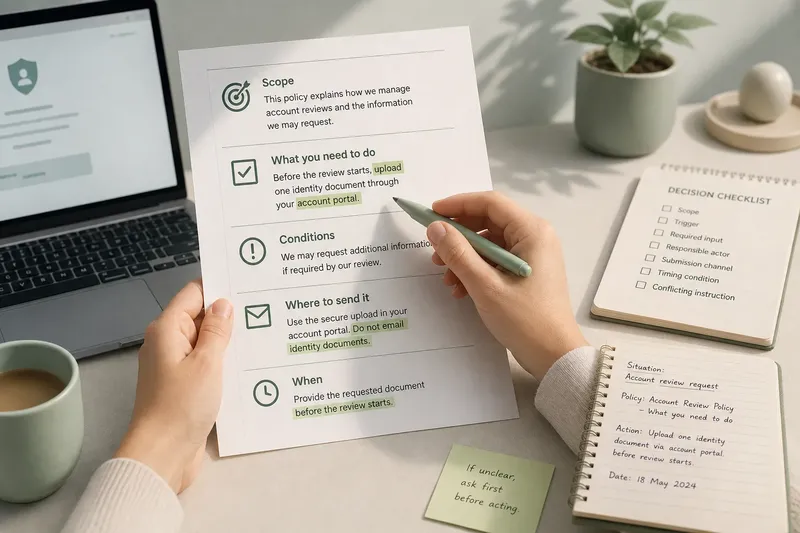
Which line in a casino policy page tells you what to do next? To read a casino policy page for a specific decision, match the rule to its scope, the action it calls for and any documents it names.
Use this method to understand the page’s instructions and organise your next move, not to determine what local law permits. If the decision has legal or financial consequences, seek guidance from a suitably qualified professional or relevant public authority.
Match rule and situation
Write down the situation in plain language, such as “I need to understand the identity documents requested before an account review.” Find the page’s scope statement and the heading nearest that subject. A general help page may point to a more specific account, verification or complaints policy.
Check whether the rule applies to your situation, rather than relying on a matching word alone. Note the page title and heading so you can return to the exact passage or refer to it in a message.
Turn wording into actions
Circle verbs that tell the reader or institution what to do: “submit”, “contact”, “provide”, “review” or “notify”. Then note the actor, the required input and the next stated action. A sentence that says documents “may be requested” does not, by itself, tell you which documents to send now.
Keep conditions attached to their instructions. Words such as “if”, “unless” and “before” can change when a rule applies. Treat a stated action like a label on a drawer: it helps you put the right item in the right place, but does not tell you what is inside an unlabelled drawer.
Check documents and channels
Look for the named form, file type, contact channel or section of the website. Check whether the page gives a secure method for sending personal information; do not send identity documents through an unrelated channel simply because it is convenient.
If two linked pages appear relevant, compare their titles, scope and instructions. Follow the more specific direction where the pages clearly address different situations; if they conflict or do not say which applies, pause and ask the organisation to clarify before sending sensitive material.
Choose the next action?
What should I do if the rule does not name my situation?
Do not assume that a similar category covers your case. Note the page title and the closest matching heading, then ask the organisation which policy applies to your stated situation.
What if two pages give different instructions?
Record both page titles and the exact actions that differ. Ask which instruction governs your situation, and avoid taking an irreversible action while the conflict remains unresolved.
How should I ask for clarification?
State the situation in one sentence, name the page and heading, and ask one direct question about the next required action. This gives the organisation a specific point to answer rather than a broad request to explain its policy.
Should I send identity documents by email?
Use only a channel the organisation identifies as suitable for sensitive documents. If the policy is silent or the channel seems inconsistent with its instructions, ask for the approved method before sending anything.
Use a decision checklist
For each item, record the observation and choose the action that follows. Keep the note beside the page title and relevant heading.
- Scope: Check whether the page names your situation. If it does, use the relevant section; if it does not, ask which policy applies.
- Trigger: Check what event makes the rule apply. If your situation matches that condition, follow the stated instruction; if it does not, do not treat the rule as applicable without clarification.
- Required input: Check whether the page names a form, document or detail to provide. If it does, prepare only that item; if it does not, ask what information is required.
- Responsible actor: Check who must take the action. If the page names you or a team, record that role; if it uses passive wording without naming an actor, ask who is responsible.
- Submission channel: Check whether the page identifies an official method for sending information. If it does, use that channel; if it does not, ask for an approved route before sharing sensitive material.
- Timing condition: Check for words such as “before”, “after” or “until”. If the condition matches your situation, follow that sequence; if the sequence is unclear, ask what must happen first.
- Conflicting instruction: Check whether another relevant page gives a different direction. If the instructions agree, proceed with the stated action; if they conflict, pause and request a clarification naming both pages.
Work through one case
Say you want to know what to provide after an account review request. Imagine, as an invented situation, that the page says to upload one identity document through the account portal before the review starts, while a linked help page says to contact support but does not mention an upload. Your starting inputs are those two page instructions, one requested document and the portal named by the policy.
First, compare the scope statements: the policy covers account reviews, while the help page offers general support. Next, note the specific action and sequence: upload the document through the portal before review. Then check whether the portal is available and whether the request identifies which document is acceptable. If both are clear, the decision is to use the named portal and provide only the requested document; if either point is unclear, the decision is to ask support which document or channel applies before sending it. The observable result is a record of the relevant pages, a specific action or a focused clarification request—not a guess about what the organisation intended.
Keep a useful record
Save the page title, heading, date you read it, exact instruction and action you took or plan to take. If you contact support, retain the question and reply with the same notes. This makes it easier to spot whether a later answer clarifies the rule or introduces a new instruction.
A careful reading of a casino policy page should leave you with a concrete next action and its conditions, or a precise question to resolve before acting. That is the practical value of the page: it helps you decide what to do with the information it actually provides.