How to Make Casino Policy Records Easier to Follow
Make casino policy records easier to follow with a clear index, verified dates and visible version status, so readers can trace each stage without guessing.
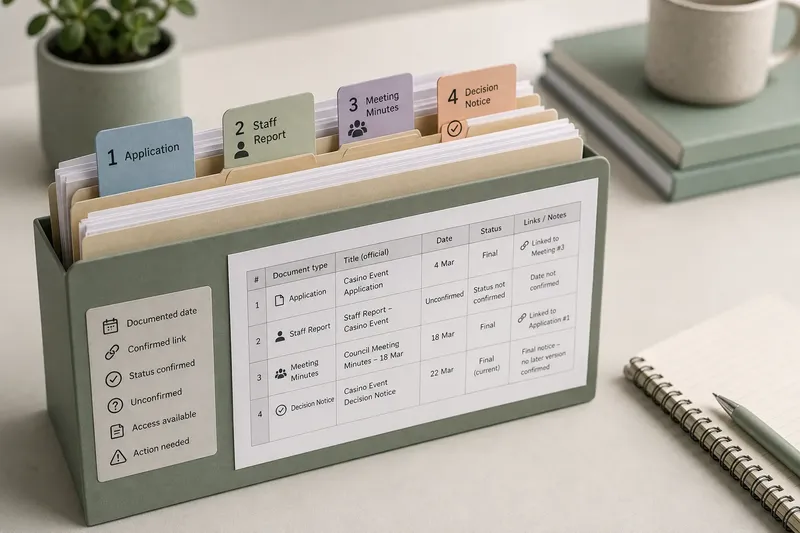
How do you tell which casino policy file belongs to which stage of a decision? A clear index of casino policy records groups documents by purpose and sequence, so readers can find the relevant material without treating the index as an explanation of the decision itself.
Imagine a council page holds an operator’s application, staff emails, meeting papers and a notice about a late-night casino event. A resident can open each file but cannot tell whether a paper is a draft, which meeting it concerns or whether a later version replaced it. The index should resolve those practical questions where the records support an answer, and show plainly where they do not.
Casino policy records
File names such as “Agenda Item 7”, “Revised Note” and “Appendix B” may be familiar to staff but unclear to someone arriving at the page for the first time. Group records by function: application, staff material, public submissions, meeting record and decision notice.
Think of the index as labels on folders, not a verdict on what is inside them. It helps readers locate the source documents and understand their relationship; it should not imply that every file was considered or that the sequence alone explains the outcome.
Building the index
Put a plain-language label beside each official file title. Add a date, meeting reference, status or link to a related record only when the information has been confirmed. Keep the original file available, so the index supports access rather than quietly replacing or reinterpreting the source.
For each entry, record what is visible and choose a next action according to the evidence:
- Document type: Check whether the title identifies an application, report, email, minutes or notice. If it does, keep that type; if it does not, add a neutral label and retain the official title.
- Date: Check the file and relevant meeting record for a date. If they confirm one, include it; if they do not, mark the date unavailable and ask the records owner to verify it.
- Status: Check whether the record is marked draft, final or superseded. If the status is explicit, reproduce it; if it is unclear, mark it “status not confirmed” and seek clarification.
- Version: Check whether another file explicitly replaces this one. If replacement is confirmed, link both and identify the current version; if not, keep both visible and avoid calling either current.
- Meeting connection: Check whether the agenda and minutes refer to the same casino matter. If they do, cross-link them; if they do not or the connection is uncertain, list them separately and request verification.
- Decision connection: Check whether a notice identifies the application or meeting it concerns. If it does, link the records; if it does not, avoid implying a connection and ask the records owner whether one can be confirmed.
- Access: Check whether the file opens and can be read. If it works, retain the link; if it fails or is inaccessible, report the problem and provide an appropriate contact route for requesting the record.
Worked index decision
Say a records officer is organising an invented set of four files about one casino event. The starting files are an application dated 4 March, a staff report with no date shown, minutes for a meeting on 18 March and a notice dated 22 March; these dates and records are hypothetical, not claims about a real council. The officer labels the files “application”, “staff report”, “meeting minutes” and “decision notice”, then checks the minutes for the application reference and asks the records owner whether the notice replaces an earlier notice.
The minutes identify the application, so the officer links those two entries. The records owner confirms that the 22 March notice is final and current, so the index labels it “final notice” and places it after the minutes; the report remains undated because no source confirms its date. The resulting index has three dated entries, one undated entry and a confirmed link between the application and minutes. The decision rule is straightforward: include a sequence or connection only when a record supports it; otherwise state what remains unconfirmed, rather than arranging files by guesswork.
Questions about records?
Should files follow upload order?
Upload order may show when staff posted files, not when they were created or considered. Keep the original links, but order the index by documented dates or stages when those are confirmed.
What if a file has no date?
Do not infer a date from its place on the page or from a nearby file. Ask the records owner to check, or mark the date unavailable and identify the document by its title and type.
How should revised files appear?
Identify a current version only when the records owner or source documents confirm that status. If an earlier file was superseded, keep it accessible and mark the relationship; if not confirmed, show the uncertainty.
What if a link does not work?
Check whether the file has moved or access is restricted. Report the broken link and provide a suitable contact route for requesting the record under the applicable disclosure rules.
What the index cannot establish
An index can help a reader trace an application, related meeting material and a notice when the links are documented. It cannot, by itself, establish who made the decision, which arguments mattered or how competing views were handled. Those questions require the relevant decision record or an explanation from the administration.
When reviewing casino policy records, check whether each file has an accurate label, a supported place in the sequence and a confirmed status. If one of those is missing, ask the administration to clarify that specific point; if you need to understand the reasoning, request the reasons or decision document separately. Keeping those requests distinct makes the record easier to use without asking an index to say more than it can.